|
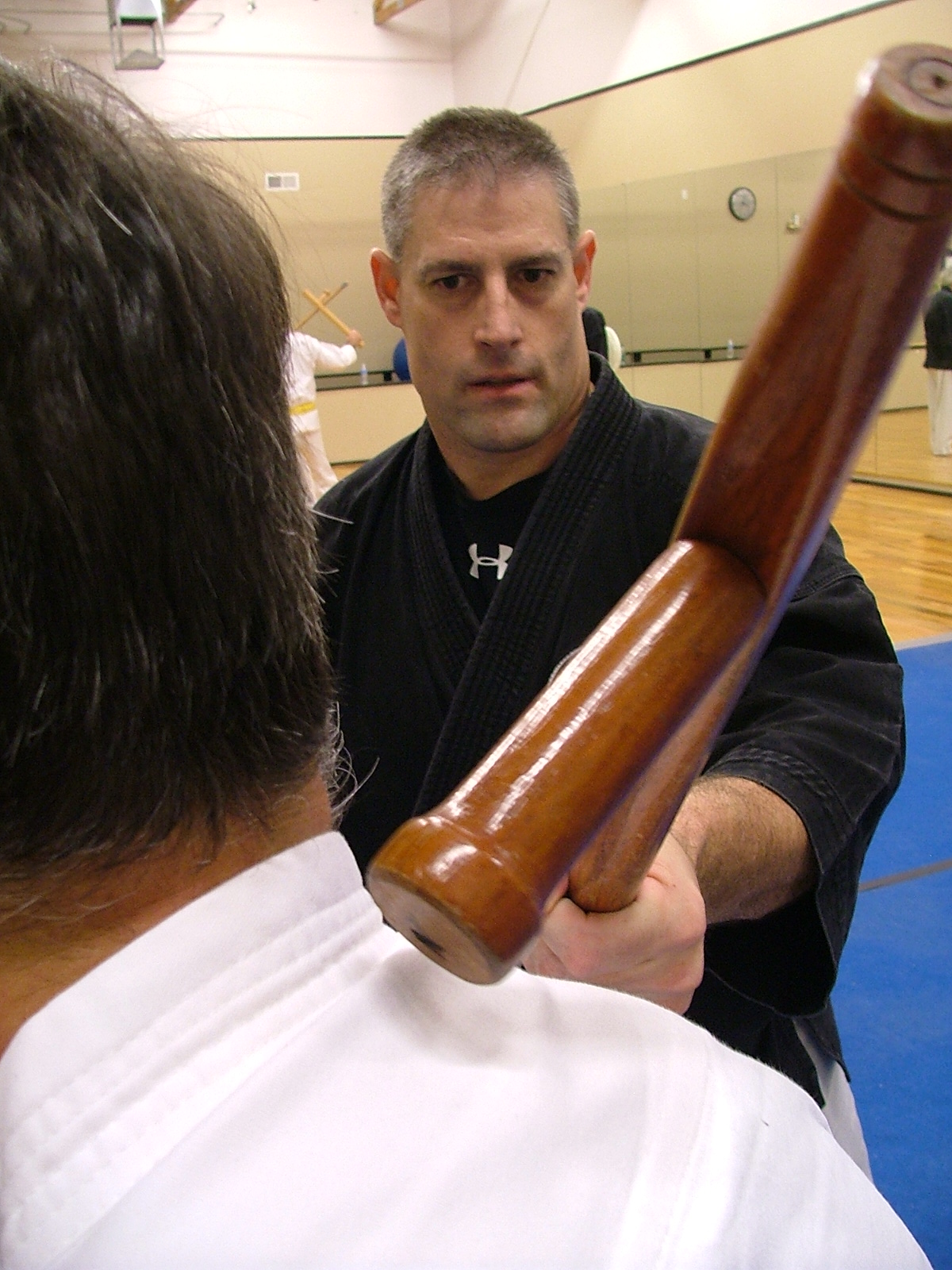
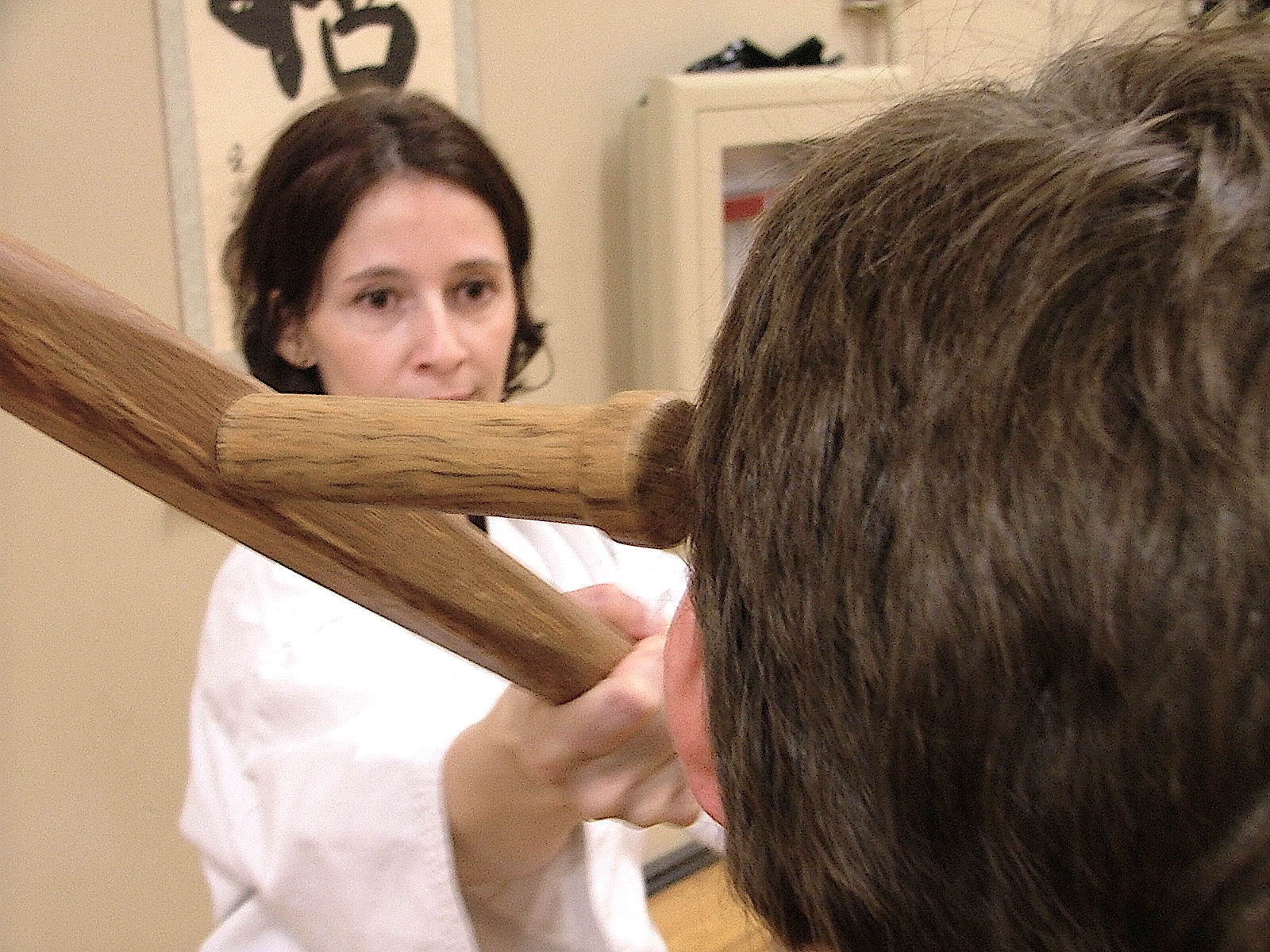
| Handle strike (hondo wa) with tonfa at the Seiyo Shorin-Ryu Hombu, Mesa Arizona. |
Similar to all other
Kobudo weapons & Okinawan martial arts, the
tonfa has an enigmatic history and may have more than one genesis. This is just one of many
kobudo weapons taught by
Soke Hausel and his instructors in the east valley of
Phoenix.
Weapons similar to the tonfa are found in other Asian countries including China, Indonesia, Thailand and the Philippines. Keep in mind few things ever develop without the influence of others and there is a tendency by Mankind to build on or modify earlier creations.
It is suggested by some historians & martial artists that the tonfa was developed somewhere else in southeast Asia and later introduced and modified on Okinawa. But others suggest the weapon was indigenous to Okinawa and there may have been a parallel evolution of weapons in other Asian countries.
%20with%20tonfa,%20Seiyo%20Hombu,%20Mesa,%20Arizona.JPG) |
Soke Hausel uses maewashi-ka (extended, or, reverse strike)
with tonfa at the Seiyo no Shorin-Ryu Karate Kobudo Kai
Hombu in the East Valley of Phoenix. |
A similar weapon was created in Thailand known as the
Mae Sun Sawk. The Thai weapon includes a rope at the elbow end of the weapon that is tied to the person’s arm unlike the Okinawan
tonfa. The Chinese version of
tonfa is known as
guai, which roughly translates as crutch (or walking stick).
Guai is thought to have originated in China prior to 700 BC. A variation of
guai is made from iron and is called a
ma guai (horse crutch). With the close relationship between China and Okinawa any connection between these two countries must always be considered.
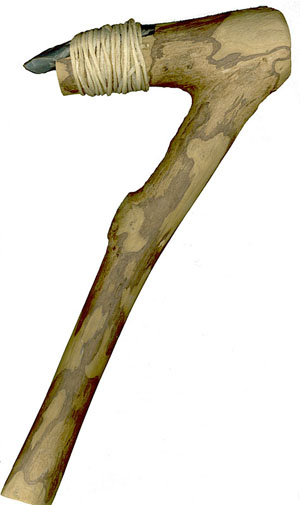
Okinawan folklore states that during the reign of Okinawan King Shō Shin, restrictions were placed on the use of bladed weapons in order to stabilize the country after a period of civil war. This restriction is said to have favored development of secretive agricultural and fishing tools as weapons of self-defense by Okinawan peasants and possibly by the Okinawa samurai caste known as Pechin. In this context, it is thought that tonfa may have been developed from a wooden handle of a millstone, a common agricultural tool. But keep in mind that the Okinawan tonfa used today is distinct from the millstone frame.
Also referred to as tong fa or tuifa, feudal Okinawans made tonfa from native tree species similar to white oak. Typically, two tonfa were used in vertical and horizontal millstones with projecting knobs inserted into sockets on either side of the stone. At this point, the millstone was driven along a trough to grind grain into flour.
 |
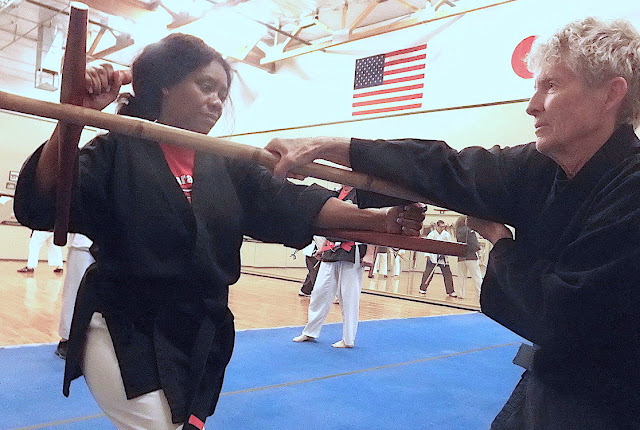
| Dr. Adam attacks with bo, which is blocked
by a defender using snapping strike (furi) to
extend the tonfa to maewashi-ka. When done
properly, furi is performed similar to snapping
a wet towel.
|
|
If the
tonfa actually originated as millstone handles, they had to be modified to produce modern
tonfa, which are now manufactured in quantity. In its original form, the handles most likely couldn’t be spun since most millstone handles were not cut precisely nor are they typically rounded and many appeared similar to a wooden hammer. Most primitive
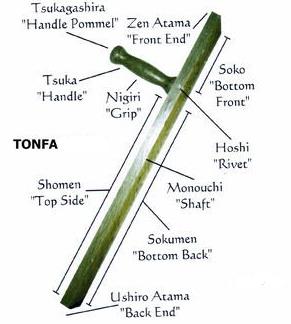
tonfa also lacked a handle pommel (
tsukagashira).
In combat, tonfa with a rounded handle can be maneuvered easily. Those tonfa with rounded shafts typically can be swung with force but some people don’t like these as they are not as effective as the flat or square tonfa in blocking heavier weapons. A rounded tonfa will not absorb the force of a blow from a bo as effectively, since it tends to focus the energy of impact into the forearm at the point of contact of the rounded surface with the forearm. The half-moon and flat tonfa more effectively redistribute energy from a blow of a heavy weapon throughout the flat surface of the weapon.
The
tonfa is just one of many weapons in the arsenal of Okinawan
kobudo (古武道).
Okinawan kobudo is also referred to as
Ryūkyū kobujutsu or
koryū and is known as "old martial arts way" referring to ancient weapon traditions of Okinawan martial arts. The weapons of
kobudo are thought to have connections with farming and fishing cultures of Okinawa. Some of these kobudo weapons include:
nunchuku, sai, kama, hanbo, nitanbo, kuai, bo, kobutan, eku, ra-ke, kuwa, manrikigusari, tanto, hari, nireki, surichin, tetsubo, tekko, tinbe, yawara, suruji, tinbe-rochin, etc.
It is common belief that these tools evolved into weapons and were developed by Okinawan peasants due to restrictions placed upon Okinawans by King Sho Shin and later by the Japanese Satsuma Samurai. However, modern martial arts scholars have been unable to verify this hypothesis and some historians now suggest that karate and kobudo was restricted to the Pechin (samurai) caste on Okinawa, rather than the Heimin (commoner). I suspect there was some influence by Heimin societies, simply because it is often discussed in Okinawan folklore and also these kobudo weapons were tools of trade for the commoner, something a member of the high society of Okinawa (Pechin) would likely have ignored.
The genius of Okinawan kobudo was the development of kobudo kata which became an extension of karate. The same strikes and blocks used in kobudo are used in karate with some minor modifications. Thus most kobudo kihon (basics) mimic karate kihon. The kobudo traditions were shaped by indigenous Okinawan techniques that were modified from imported methods principally from China.
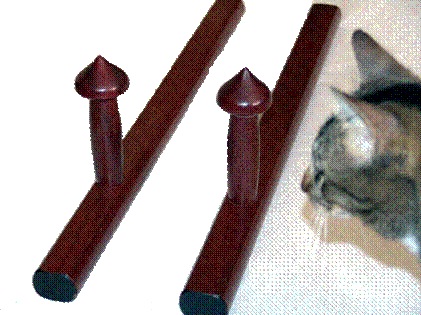
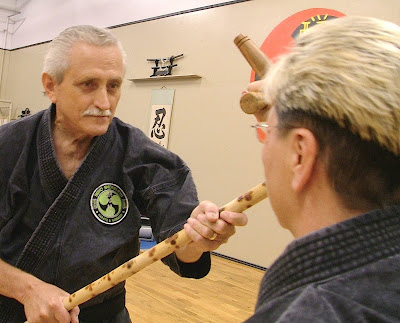
The characteristics of tonfa (see photo on right from Nasiakos Spyros, Hanshi/9th dan, World Okinawa Seishinryoku Karate Do Federation, Athens, Greece) are that it is gripped by the short perpendicular handle (nigiri) or by the longer main shaft (monouchi) at the back end (ushiro atama). When the handle is grasped, the shaft protects the forearm and hand while the knob (tsukagashira) and (tsuka) protects the thumb. If the end (ushiro atama) of the shaft is held, the shaft (monouchi) can be used to ward off blows while the handle (tsuka and nigiri) is used as a hook to catch the opponent's weapons, arms, legs and/or neck.
In offense, one can swing the shaft to strike. Large amounts of energy can be imparted to the shaft by twirling the tonfa by the handle. The tonfa can also be wielded in such a way as to use the knob as a striking implement similar to a hammer. One can also thrust either end of the shaft (ushiro atama or zen atama) to strike an attacker.
Tonfa are traditionally wielded in pairs, one in each hand. This is unlike law enforcement agencies that typically use one nightstick. The effectiveness of the tonfa as a law enforcement tool was seen in its use worldwide.
The size of tonfa is determined similar to sai and should extend about one inch beyond the elbow for combat: however, it is recommended that for dojo use and practise that the weapon only extend to the tip of the elbow. The shaft is typically 20 to 24 inches in length.
The weight of the weapon is important. The weapon should not so light that you lose power and focus, and should not be too heavy that it cannot be maneuvered with speed. Three traditional grips (1) natural (honte mochi), (2) reverse (gyakute mochi), and (3) special grip (tokushu mochi) are used.
"We support American values, the US Constitution, and facts; so, we can no longer support facebook or linked-in" - Soke Hausel
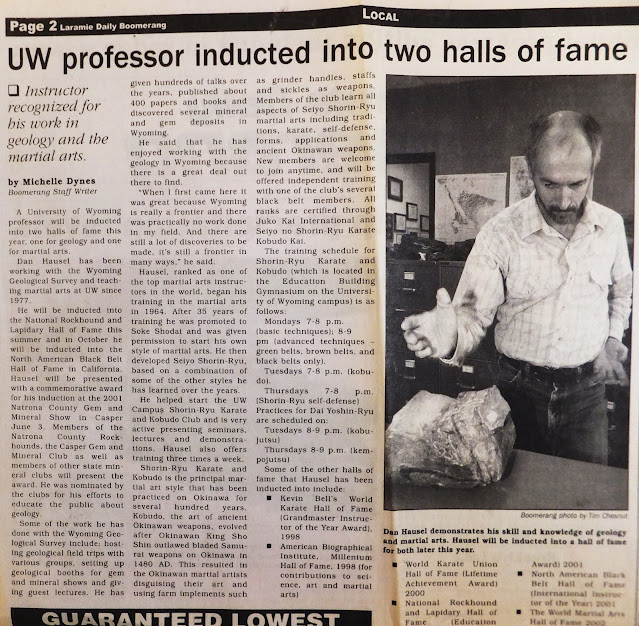 |
University of Wyoming martial arts professor and research geologist at the
Wyoming Geological Survey on the UW campus inducted into two Halls
of Fame in the same year for two different professions. |
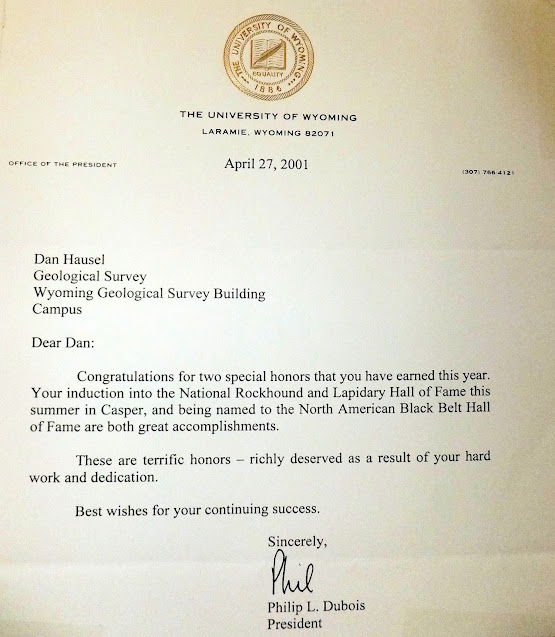 |
Letter from University of Wyoming President Philip Dubois
acknowledging induction of Soke Hausel into two Halls of Fame |
%20Seiyo%20Shorin-Ryu%20Hombu,%20Mesa,%20AZ.JPG)


.JPG)


%20with%20tonfa,%20Seiyo%20Hombu,%20Mesa,%20Arizona.JPG)

.JPG)